
Muscle maintenance is one of the hot topics in fitness right now due to various doctors stressing its importance during the menopause, alongside numerous studies showing how weight loss jabs are causing significant muscle loss as body fat drops.
This is on top of the huge amount of evidence showing that many of the age-related declines we suffer are reduced when people have more muscle, from dementia risk to mobility. It goes without saying that muscle helps with sports performance and looking toned on the beach. With that in mind, here’s what you need to prioritise to build or maintain muscle.
The Stimulus to Grow Muscle – You will never build muscle if you don’t give your body a signal to grow new tissue. Likewise, you can only maintain it if you give your body a reason to keep it. This is the fundamental rule of muscle development: tell the body it needs to keep what it has and add a bit more.
What counts as a stimulus depends on where you are right now, like we discussed with VO2 max the other week. If you’ve trained for years and already have a lot of muscle, you need to work hard to gain more. But most people have done hardly anything, which means they also need to do very little to see improvement.
Muscle is stimulated when it’s forced to work against resistance that it’s not fully accustomed to. For a beginner, that could mean doing one set of exercises per body part once a week, it might only take 15 minutes. Even day-to-day activities can trigger a response, like lifting heavy things in the garden or carrying shopping up the stairs.
Progressive Overload – Giving your body a reason to grow muscle is half the story. The other half is how to keep that signal going. This is where progressive overload comes in, you need to keep slightly increasing the challenge so the body doesn’t adapt and plateau.
The main things to change are frequency, intensity and volume. For example, instead of training once a week, you might do twice (frequency). You could lift a heavier weight for 6 reps instead of a lighter one for 12 (intensity), or increase total sets per muscle group from 5 a week to 8 sets (volume). You can also vary exercises, lifting tempo, or how close to failure you go.
As you get more muscular, you’ll need more structure and planning. At the top level, this becomes true sports science. But in the beginning, all you need to do is find where your body is now and give it the easiest possible challenge that still makes it grow, then adjust slowly over time.
Consistency – The final pillar is consistency. You can’t go for long stretches without giving your body a growth signal. People massively exaggerate how quickly they lose muscle, a few days off does nothing. Even a few weeks off won’t wipe out your gains if you’ve trained consistently beforehand. The only time I’ve seen real rapid muscle loss is after injury or complete inactivity.
That said, don’t make the mistake of stopping altogether for long stretches. To maintain muscle, it takes very little, just one short session or a few hard sets every week can be enough for the body to keep hold of what it has.
Modality – It doesn’t matter how you do it. The gym is the obvious choice but many people hate it. I used exercise bands and bodyweight training for years and built plenty of muscle that way. I’ve filmed over 50 home workouts for clients using nothing but bands. You can also build muscle through calisthenics, pole fitness, or sports with strong resistance elements like rowing or climbing.
Avoid getting caught up thinking muscle growth only happens from 8 to 12 reps with dumbbells. I built plenty of muscle doing Hyrox, where I’d lunge 150 metres at a time. Cyclists prove the same thing, their sport is mostly aerobic, yet short high-resistance hill climbs mimic weight training for the legs. Pick the form of resistance you’ll actually stick to, and just get going. Then be ok with varying and changing this over time.
Calorie Intake – If you’re consistent with a progressively harder stimulus over time, you’ll gain muscle. This can happen while eating fewer calories than you burn, though the best muscle gain usually comes when you’re eating around maintenance or slightly above.
Protein Intake – How much protein you need depends on your size, training frequency and goals. The fewer calories you eat, the more protein matters. I wrote just last week about how to eat more protein, as most people are miles under where they should be.
What This Means For You
At a practical level, you need to start strength training in some form, hitting each muscle part once a week but ideally twice a week. You can do this at home using my exercise band videos, join a class, or train in a gym. It takes a little time to learn, but anyone can pick it up. You might also find my daily routines are a good entry point , they take just a few minutes and can be done anywhere.
Building and maintaining muscle isn’t just for athletes or bodybuilders. It’s one of the biggest factors in ageing well, staying injury-free, and keeping your metabolism healthy. Think of it as your body’s armour, it protects you, empowers, and keeps you younger for longer.
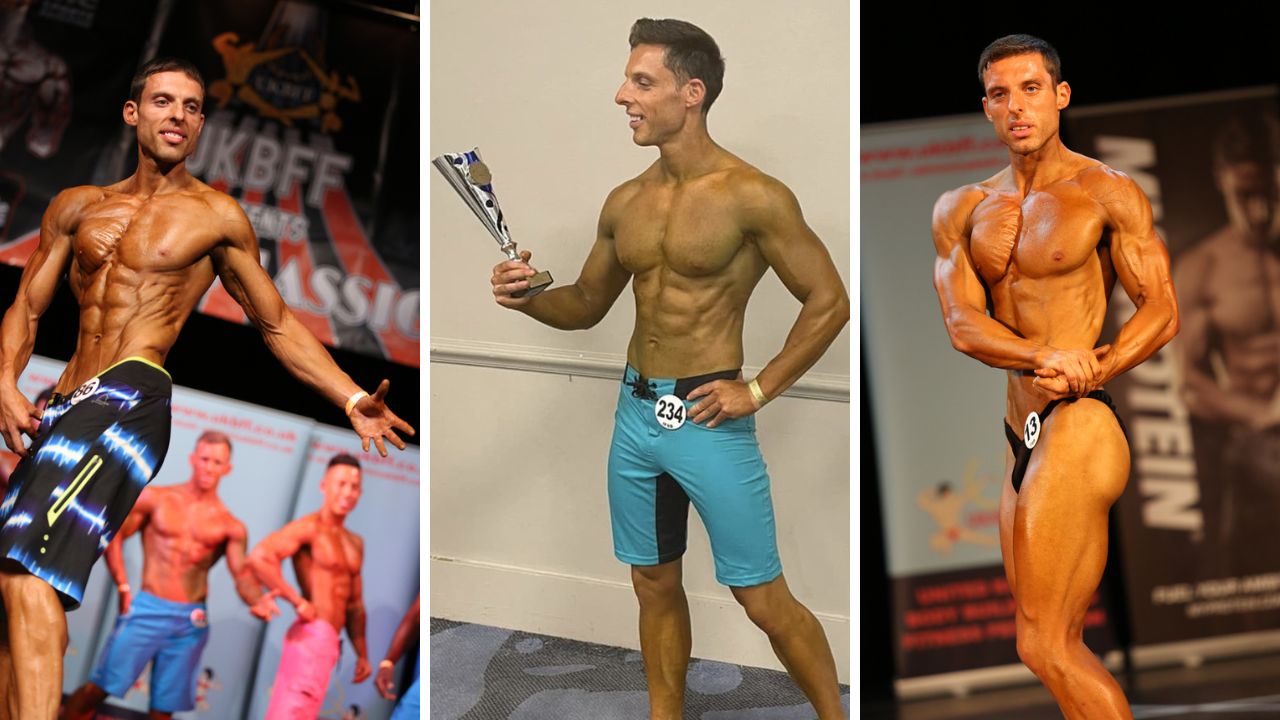
Photo – I was never a big guy, but I enjoyed the mental game of competing in bodybuilding, even though I wasn’t very good at it I did 5 shows in total. I got a trophy in the over 40’s category and resisted any urges to take performance enhancing substances so a win all round I say:
Need Support Getting In Shape?
Changing your body on your own without support or an effective system usually ends in failure sadly. To avoid this outcome you can become one of my coaching clients either online or in person. I provide Holistic, Healthy & Sustainable Body Transformations. Contact me to discuss your goals further or see below for more details and the options available to you based on your location / preferences:
Worldwide (Online) –
For transformations, coaching and support wherever you are in the world read more here>>>>
London (Battersea) – If looking for Personal Training Battersea please contact me. I am available for sessions in homes, private gyms or Personal Training Battersea Park. To see my locations please visit my Battersea Personal Trainer page>>
London (Oval / Kennington) – For Personal Training in Oval & Kennington please contact me. I am available for sessions in homes, private gyms or parks.
**************
Read My Book – The Grand Unified Theory of Weight Loss – My latest book is available in print, kindle/ebook and audio formats. You can read more about it and see where it is available here>>>
Follow Me – You can get more great advice, tips, hacks and more by following me on one of my social media channels. Follow Me>>>
Instagram>> You Tube>> Facebook>> Twitter>> Tik Tok>> My Weekly Newsletter>>
**************